Friday turned out to be a rough session for Indian equity markets. Why Nifty 50 Fell Today The Nifty 50 closed in the red, and while the fall wasn’t dramatic, the index simply couldn’t hold on to any buying interest throughout the day. The mood was cautious — and honestly, a little disappointing for those who were hoping the RBI’s policy update would spark some optimism.
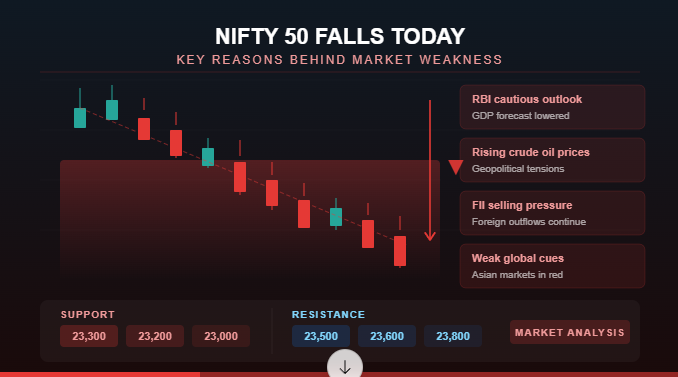
So, What Actually Went Wrong?
1. The RBI Played It Safe — Maybe Too Safe
The central bank held the repo rate steady at 5.25%, which nobody was really surprised by. But what caught attention was the tone that came with it. The RBI trimmed its GDP growth estimate and flagged higher inflation risks, pointing to rising global uncertainty and expensive crude oil. For investors, that kind of language doesn’t inspire confidence — and a fair bit of profit booking followed.
2. Crude Oil Isn’t Helping
Oil prices have been climbing again, largely because of ongoing tensions in the Middle East. For a country that imports most of its oil, this is always a sensitive topic. Higher crude means higher costs across industries, and that tends to put a damper on market sentiment pretty quickly.
3. Foreign Investors Are Still on the Sidelines wait for market patience
FIIs have not exactly been rushing into Indian equities lately they see the fundamentals of companies , Currency volatility, global growth worries, vision and general caution have kept them defensive and safe. That steady outflow of foreign money adds an extra layer of selling pressure that domestic buying alone can not always absorb.
4. Global Markets Set a Gloomy Tone
Asian markets were also trading in the red, and the broader global mood leaned toward risk-off. When international investors pull back, it rarely stays contained — and Indian markets felt that spillover effect today.
5. Resistance Levels Triggered Profit Booking
After a decent recovery attempt in recent sessions, the market ran into familiar resistance zones. Many short-term traders decided to lock in gains rather than push their luck in an uncertain environment. That kind of defensive behavior adds to the downward drift.
How Did Different Sectors Hold Up?
Banking stocks actually held up reasonably well after the RBI’s announcement. Defence continued to see interest, which has been a consistent theme lately. FMCG stocks struggled under inflation pressure, and IT was a mixed bag — neither a drag nor a driver for the day.
What Should Investors Do Right Now?
Honestly if one bad session doesn’t tell you much about where a stock or the market is headed. Long-term investors are better off ignoring the daily noise and focusing on companies with solid fundamentals they also saw the market higher timeframe. If you are someone who trades shorter timeframes keep a close eye on gift nifty,crude oil, FII data, and how global markets open next week before making any big moves.also keep eyes on war situations
Levels to Watch for the Next upcoming Session
Support
23,300 is the very important level. Below that, 23,200 matters, and 23,000 is a major psychological and emotions level that would concern a lot of participants if tested.
Resistance
23,500 is the immediate hurdle. A move past 23,600 would be encouraging, and 23,800 is the zone that would really change the narrative.
As long as the index holds above 23,300, there’s a reasonable chance of a bounce toward the 23,500–23,600 range. A clean break below 23,300, though, and weakness could extend further.
The Bottom Line
Today’s decline came from multiple directions at once — a cautious RBI, rising oil prices, foreign outflows, and soft global cues all played a part. There’s no single villain here. The market is currently range-bound, and that’s likely to stay the case until some of these overhanging concerns start to clear up. Stay patient, manage your risk, and don’t let a single session dictate your strategy.
Disclaimer
This article is only for educational and informational purposes only and should not be considered investment advice. Investors should conduct their own research or consult a financial advisor before making any investment decisions also