So you’ve probably heard someone throw around the term “F&O” like everyone’s supposed to know what it means. Maybe a cousin mentioned he made decent money in options last month. Or you saw a news headline about an “F&O ban” on some stock and just quietly moved on without really understanding it. If that’s you, relax, you’re in good company. Most people nod along when F&O comes up in conversation without actually knowing what’s going on underneath.
I’m going to try and explain this the way I wish someone had explained it to me, without throwing ten new terms at you in the first two lines.
What is F&O
Okay, so what does F&O actually mean
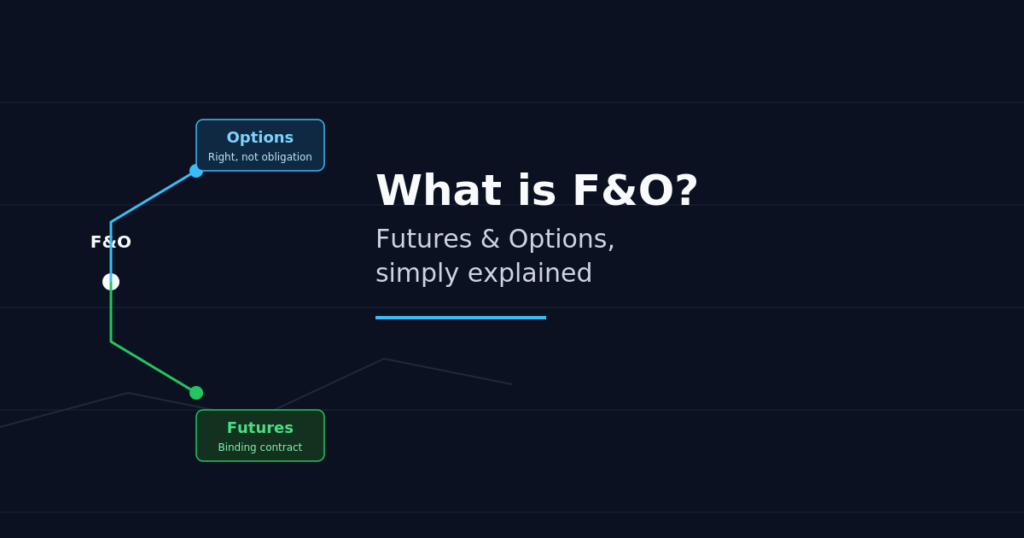
F&O is short for Futures and Options. Two different types of contracts that people trade in the stock market. And that word, contract, is really the whole starting point here. When you buy a share of, say, Reliance or TCS, you’re buying an actual piece of that company. Tiny, but real ownership. F&O doesn’t work like that at all. You’re not buying anything real. You’re agreeing to a deal based on where you think the price of something is headed, usually a stock or an index like Nifty or Bank Nifty.
Here’s an odd way to think about it. Imagine betting a friend on what the price of a house in your neighborhood will be six months from now. You never touch the house, never own it, but if your guess is right, you still make money off the difference. That’s roughly the vibe of F&O, minus the actual real estate involved.
Futures first, since it’s the simpler one to grasp
A futures contract is basically a promise between two people. Buy or sell something at a fixed price, on a fixed date, no matter what’s actually happening in the market that day.
Say a stock is at ₹100 today. You’re convinced it’ll go up, so you lock in a futures contract to buy it at ₹100, a month from now. Two things can happen after that. If the price climbs to ₹120 like you hoped, great, you still get it at ₹100 and can sell right away at the higher price. Nice little profit. But if it drops to ₹80 instead? Doesn’t matter. You still have to buy at ₹100 because that’s what you agreed to. Now you’re down ₹20 a unit even though the stock is cheaper everywhere else.
That’s the part people underestimate about futures. There’s no opting out halfway. Once you’re in, you’re in.
Now options, and this is where people usually get confused
Options work a bit differently, so stick with me here.
With an options contract, you get the right to buy or sell something at a set price before a certain date, but here’s the key bit, you’re not obligated to actually go through with it. That single word, right, changes everything compared to futures. If the trade isn’t going your way, you can just let the contract expire. Walk away. The only thing you lose is a small upfront amount called the premium.
Two flavors of options exist. A call option gives you the right to buy, and people usually go for this when they think a price is going up. A put option gives you the right to sell, used when someone expects a price to fall.
Quick example. A stock’s at ₹100, and you buy a call option letting you purchase it at ₹100 anytime over the next month. You pay ₹5 for that right. If the stock jumps to ₹130, you exercise the option, buy at ₹100, and you’re sitting on a solid profit after subtracting that ₹5. But if the stock tanks to ₹80? You just don’t bother using the option. Let it expire worthless. Total damage: ₹5. That’s it.
This right there is the big difference between the two. Futures can hurt you badly because you’re locked in no matter what. Options, at least when you’re the buyer, cap your loss at whatever premium you paid going in.
Why does anyone even bother trading this stuff
A few genuine reasons, honestly, not all of it is reckless gambling.
Hedging is probably the original point of F&O existing at all. Big companies and institutional investors use these contracts to protect themselves from price swings. A classic example is a farmer locking in the price of his crop months in advance through a futures contract, so a sudden price crash at harvest time doesn’t wipe him out.
Then there’s leverage. F&O lets you control a fairly large position without putting up the full amount, which means your profits (on paper, anyway) can look a lot bigger than regular stock trading. Obviously the same leverage works against you just as easily.
And then, let’s be real, a lot of people are just speculating. Betting on which way a price will move without any actual interest in owning the stock underneath it all.
Why F&O has such a bad reputation
If you’ve read anything about F&O trading in India over the past year or two, you’ve probably come across some grim statistics about how many retail traders end up losing money here. This isn’t media exaggeration either, SEBI has actually studied this. Their data showed something like 9 out of 10 individual traders in the F&O segment lost money across recent financial years, and the total losses ran into lakhs of crores of rupees. Sit with that number for a second before deciding this looks like easy money.
Once you understand how F&O actually works, the reason for this becomes pretty obvious. The same leverage that makes F&O tempting is exactly what makes it dangerous. Small price moves can blow up your position fast when you’re controlling that much with so little capital behind it. Add to that the fact that most beginners have never even heard of something like time decay (basically, an option loses value the closer it gets to expiry, even if the stock price hasn’t budged much), and you’ve got a pretty reliable setup for losing money.
There’s an emotional side to this too, one that doesn’t get talked about enough. F&O contracts expire. That built-in deadline creates a kind of pressure regular stock investing just doesn’t have. If you buy a stock and it dips, you can wait it out, sometimes for years if needed. F&O doesn’t give you that luxury. The clock’s always running.
Should a beginner even go near F&O
My honest take, if you’re new to the market, this isn’t where you should start. It genuinely requires understanding how contracts work, how price gets affected by things beyond just the stock itself (time, volatility, all of it), and a level of discipline around risk that most people only build after making a few costly mistakes.
Most seasoned traders will tell you roughly the same thing. Learn plain stock investing first. Get a feel for how prices actually move, get comfortable with basic charts and fundamentals, and only look at F&O later, ideally with money you’re genuinely okay losing while you figure things out.
And if you do eventually want to try it, start small, maybe even paper trade for a while first, and actually take the time to understand concepts like option Greeks, expiry mechanics, and margin requirements before you put in any serious amount.
Conclusion
F&O isn’t some secret club only finance geeks understand, but it’s also not something you casually wander into because a stranger’s profit screenshot looked convincing on Instagram. Futures lock you into a deal with real risk on both sides. Options give buyers a bit more breathing room since your downside is capped, but they come with their own headaches, time decay and volatility being the big ones.
Take your time understanding what you’re actually signing up for before real money’s on the line. The market isn’t going anywhere. It’ll still be there next month, next year, whenever you’re actually ready for it. No bonus points for rushing in early.
Disclaimer: This article is meant purely for educational purposes and general awareness. It is not financial advice. Futures and Options trading involves substantial risk and is not suitable for all investors. Please consult a certified financial advisor before making any investment decisions.
https://sharemarketalert.com/intraday-trading-for-beginners-rules-risks/