Renewable Energy Stocks India 2026
Let me be honest with you. Three years ago, if you told someone to put serious money into Indian renewable energy stocks, they’d probably laugh a little and say, “Yaar, ye sab future ki baat hai.” And now? That future is right here. Right now. And the ones who believed early are sitting on some of the most remarkable returns this market has seen in a generation.
This is not a story about speculation. This is a story about a country that’s genuinely transforming — and the companies riding that wave.
India’s Renewable Story Is No Longer a Prediction
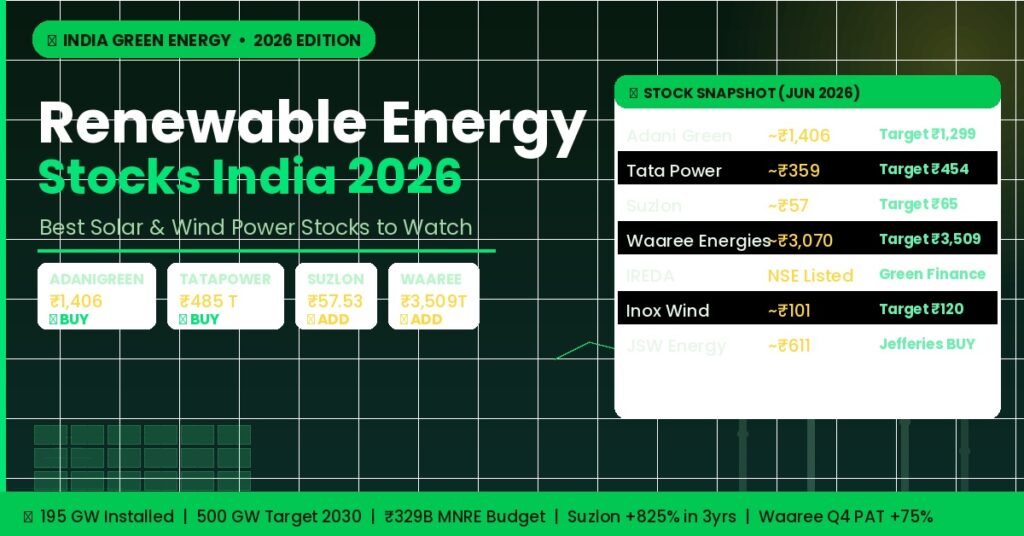
Here’s where we stand today: India has crossed over the 195 GW of installed renewable capacity as of 2026. Non-fossil fuel sources now account for nearly 49% of total power capacity. The government’s 500 GW target by 2030 isn’t some political slogan anymore it’s a construction timeline, and it’s moving fast.
The MNRE got a record budget allocation of ₹329 billion for 2026-27. Solar alone received ₹305 billion. Green hydrogen got ₹6 billion. Wind energy is seeing fresh capex. These aren’t promises they’re line items.
And the kicker? Solar energy costs have dropped over 85% in the last decade. The economics of clean energy have quietly become unbeatable. When renewable power is cheaper to generate than coal in more and more scenarios, the investment case writes itself.
So let’s get into the stocks.
Best Renewable Energy Stocks in India 2026
1. Adani Green Energy (ADANIGREEN)The Heavyweight
There’s no list without Adani Green. Love the group or hate the controversies, the fundamentals here are hard to argue with. The company is one of India’s largest renewable energy platforms — solar, wind, and hybrid projects spread across the country.
In May 2026, the company operationalised a 50 MW solar project at Khavda, Gujarat through its subsidiary, continuing its relentless capacity additions. Jefferies has a Buy rating with a revised target of ₹1,299 while JM Financial recently had it at ₹1,204. The stock was trading around ₹1,406 in early June.
The risk? The Adani group name comes with headline risk. Any global news event touching the group can shake the stock even when the underlying business is fine. Keep that in mind for position sizing.
2. Tata Power (TATAPOWER) The Safer Bet
If Adani Green is the aggressive play, Tata Power is the more comfortable one. It’s diversified solar, wind, hydro, EV charging infrastructure, rooftop solar. Q4 FY26 PAT came in at ₹1,416 crore, up 8% YoY even as revenue faced some pressure from Mundra-related headwinds.
Jefferies actually has an Underperform on Tata Power right now which is worth noting but MOFSL has it at a target of ₹454, and PL Capital at ₹359. The difference reflects a debate about near-term valuation stretch versus long-term positioning.
What’s undeniable: Tata Power’s renewable pipeline is serious, and its brand strength in rooftop solar and EV charging gives it multiple growth levers that most
3. Suzlon Energy (SUZLON) The Wind Giant Making a Comeback
This one is personal for a lot of investors. Suzlon almost went bankrupt a decade ago. Debt-laden, restructured, barely surviving. And then a slow, painful, beautiful turnaround. The three-year return on this stock has been nothing short of extraordinary at over 825%.
In March 2026, Suzlon was trading around ₹41. JM Financial gave it a Buy with a target of ₹64-65, implying about 54-57% upside. Revenue was expected to surge 51% YoY on the back of higher dispatches 874 MW in Q4 FY26 versus 573 MW a year earlier. The company has locked in massive orders including 838 MW from Tata Power Renewable and 1,544 MW from NTPC Green.
May was a consolidation month after April’s sharp rally the stock finished around ₹57. That’s what healthy profit-taking looks like after a strong move.
If you’re looking for wind energy exposure in India, Suzlon is practically the only serious listed pure-play option.
4. Waaree Energies (WAAREEENER) Solar Manufacturing Powerhouse
Waaree is a different kind of renewable bet it’s not a power generator, it’s a solar manufacturer. And the scale is impressive: module production jumped to 12.6 GW in recent quarters, Q4 PAT was up 75% YoY, and the order book stands at an extraordinary ₹53,000 crore with a pipeline above 100 GW.
The stock was around ₹3,070 in early June, off its 52-week high of ₹3,865. JM Financial has it at ₹3,509 with an ‘Add’ rating. The company has also announced ₹30,000 crore in capex and a ₹10,000 crore fundraising plan which brings equity dilution risk into the picture.
The US anti-dumping exposure on the export book is a real watch item. But for domestic solar manufacturing, Waaree is arguably the most powerful name on the board.
5. IREDA (IREDA) The Silent Financier of India’s Green Future
If you don’t want to pick individual power companies, IREDA is your cheat code. It’s a government-backed financial institution that funds renewable energy projects solar, wind, hydro, biomass, everything. When India builds more clean energy capacity, IREDA’s loan book grows.
The MNRE allocation boost directly feeds IREDA’s pipeline. It’s not a glamorous pick no massive capacity announcements, no GW headlines but the risk-reward for a long-term SIP-style accumulation is genuinely compelling.
6. Inox Wind (INOXWIND) The Undervalued Wind Play
MOFSL noted something interesting: wind players like Suzlon and Inox Wind are trading near or below Mean -1 Standard Deviation on 1-year forward P/E, despite likely earnings CAGRs of 31-32% over FY25-28. That’s a mismatch that patient investors love to find.
JM Financial has a target of ₹120 on Inox Wind. Revenue is expected to jump 30% with execution rising to 310 MW versus 236 MW a year earlier. The company is small but the order pipeline is real.
7. JSW Energy (JSWENERGY) The Rising Platform
Jefferies named JSW Energy, Adani Energy, and NTPC as their top picks right now (as of June 9, 2026). JSW Energy has been quietly building a diversified energy platform conventional, solar, and storage. Target prices range from ₹611 (MOFSL) to ₹642 (JM Financial).
The recent QIP proceeds and improving leverage ratios caught Jefferies’ attention. Power demand in April-May 2026 is running at 7% YoY growth above estimates and JSW is well-positioned to capture incremental capacity.
Risks You Cannot Be Ignore
I would be doing you a disservice if I didn’t say this clearly:
Valuations are stretched means The utilities sector is trading at a P/E of around 20x, which is 51% above the 10-year average. Some of these stocks have priced in a lot of good news already. Buying at peak sentiment is never comfortable.
Curtailment is a real issue means India reported 470 MU of renewable curtailment in January-March 2026 that’s 0.7% of total solar and wind generation. It’s lower than China’s numbers, but transmission infrastructure gaps are real. New deviation settlement regulations could create 1.5-2% revenue headwinds for some companies.
Policy dependency is high means These companies grow on government contracts, SECI auctions, and policy support. Any political shift even a temporary one can create volatile quarters.
So Should You Invest?
Here’s my honest view: if you have a 5-7 year horizon, India’s renewable energy story is one of the most structurally sound investment themes you can find in any emerging market right now. The government is committed, the economics work, the demand is real, and the companies are executing.
But don’t go all-in at once. The sector can be volatile. It corrects hard when the broader market gets nervous. The smarter play? Build positions in phases maybe a core of Tata Power or IREDA for stability, a growth bet on Suzlon or Inox Wind for upside, and a sector bet on Waaree for manufacturing exposure.
The energy transition is real. The question is just timing and discipline.
Disclaimer: This blog is for informational and educational purposes only. It does not constitute investment advice. Please consult a SEBI-registered financial advisor before making any investment decisions.
Why Are PSU Stocks Surging? The Real Story Nobody Is Fully Telling You